Solar panels are only one part of a working solar power system. You also need an inverter to convert the electricity produced by your panels into electricity your home, farm or business can use.
Choosing the right inverter for solar panels affects system performance, shade tolerance, monitoring, battery compatibility and future expansion. The best option depends on your roof, electricity needs, budget and whether you want backup power.
For a simple, largely unshaded roof, a string inverter may be the most economical choice. Microinverters and power optimizers are often better for roofs with shade or multiple orientations. If battery storage is part of your plans, a hybrid inverter may provide the most straightforward path.
This guide compares the main types of inverters for solar systems and explains how to choose the right technology for your property.
Before diving too deeply into the differences among the various types of inverters, it is important to first understand what an inverter actually does: Your solar panels produce DC (direct current) energy. Unfortunately, this is not the proper format for your home to make good use of that energy. It must instead be converted into AC energy. An inverter’s primary function is to help convert your produced energy from DC to AC power. However, there are several different ways that inverters can go about this. This is why there are three main types of inverters for homeowners or business owners to choose from.
If you are on the fence about what type of inverter you want or need, this guide will explore the differences:
Solar panels produce direct-current electricity, commonly called DC electricity. Most homes and businesses use alternating-current, or AC, electricity.
A solar inverter converts the DC electricity generated by your panels into AC electricity that can be used by your appliances, equipment and electrical system. Depending on the model, a modern inverter may also:
A standard grid-tied inverter does not necessarily keep your property powered during an outage. Most grid-connected systems shut down automatically when the grid goes down to protect utility workers. Backup power requires compatible equipment, such as batteries, transfer controls and properly configured backup circuits.
A string inverter connects a group—or “string”—of solar panels to one central inverter. Electricity from the panels travels to the inverter, where it is converted from DC to AC.
String inverters are widely used because they are straightforward, cost-effective and relatively easy to access for servicing. They can be a strong choice when panels face the same direction and receive similar amounts of sunlight throughout the day.
Shade, snow, debris or differences between panels can affect the output of a connected string. The effect depends on how the system is designed, the inverter’s MPPT configuration and whether panel-level electronics are installed.
Because one central inverter handles a large portion of the system, an inverter problem may also interrupt production from the connected array until it is repaired.
A microinverter is installed at each solar panel rather than using one central inverter for the entire array. Each panel converts its DC electricity into AC electricity independently.
This design is often useful for roofs with partial shade, multiple roof faces or panels installed at different angles. If one panel produces less electricity, the remaining panels can continue operating according to their own conditions.
Microinverters generally cost more upfront because each panel requires its own device. They are also installed on the roof beneath the panels, which can make replacement more labour-intensive than servicing an accessible central inverter.
Microinverters do not automatically provide power during an outage. Backup capability still requires a compatible battery system and the necessary electrical controls.
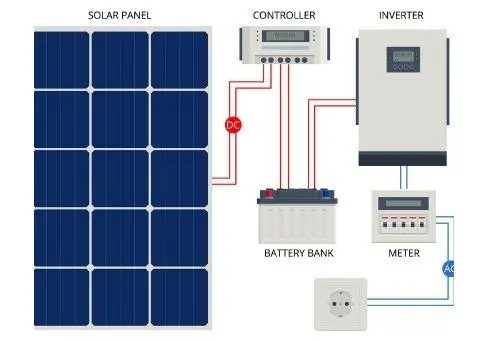
Battery inverters are a bit different than the more plentiful solar inverters. Their primary job is to charge your battery banks. While they do convert DC power to AC power, the thing that sets a battery inverter apart is its capability of doing the opposite as well. This makes them part of an essential system, whether you have solar power or not.
Some people choose to use battery inverters even without a solar system because it enables them to use less expensive electricity instead of paying for peak hours.
Many people are already familiar with the plug-in battery inverters that are often used in travel, such as on RVs, caravans, or even boats. In these cases, the battery inverter will typically be paired with one or more solar panels to store energy needed for the trip.
The benefit of going with a battery inverter is that it has the potential to be as powerful as you want it to be. They will often range from 150W for suitable uses in vehicles all the way to battery inverters that exceed 10,000W. The latter can take you all the way off-grid if that is your end goal when converting to solar energy.
A hybrid inverter combines solar conversion and battery-management functions in one unit. It can convert DC electricity from solar panels into AC electricity while also directing excess solar production into a compatible battery.
When electricity is needed later, the inverter can draw stored energy from the battery. Depending on the design, it may also coordinate electricity from the grid or another approved energy source.
Not every battery works with every hybrid inverter. Battery voltage, communications, output capacity and manufacturer compatibility must all be confirmed.
A hybrid inverter also does not guarantee whole-building backup. The system must be designed around the loads you want to operate during an outage. Many properties use a dedicated backup-load panel for essential equipment rather than attempting to power every circuit.
There is no single inverter that is best for every property. A qualified solar designer should consider the following factors.
A string inverter may work well when panels are installed together on an open, consistently sunny roof. Microinverters or power optimizers may be preferable when panels face different directions or experience partial shade.
If you want battery storage now, a hybrid inverter may simplify the system. If you already have solar, an AC-coupled battery and battery inverter may provide a practical retrofit option.
Planning ahead is important. Adding storage later can be more complicated when the original inverter was not selected with battery compatibility in mind.
An inverter should be sized according to the solar array, expected production, electrical service and property loads. Solar panels and inverters do not always need identical nameplate ratings; designers may use a calculated DC-to-AC ratio to improve system economics and real-world performance.
This calculation should be completed using the inverter manufacturer’s permitted voltage, current and operating limits.
Decide which circuits need electricity during an outage. Refrigeration, lighting, communications, heating controls, water pumps and essential business equipment may take priority.
The inverter and battery must be capable of starting and operating those loads. Whole-home or whole-building backup usually requires substantially more capacity than an essential-load system.
Some owners want basic system-level production data, while others want to monitor every panel. Confirm what the inverter monitors, how the data is accessed and whether the monitoring platform requires ongoing fees.
Compare both product warranties and the labour involved in replacing equipment. A long equipment warranty does not always cover installation labour, shipping or lost solar production.
Ask whether replacement products and local technical support are likely to remain available throughout the expected life of the system.
Solar equipment in Canada must operate through significant seasonal temperature changes. Equipment location, ventilation, weather protection and operating-temperature limits should be considered during system design.
The selected inverter must also meet applicable Canadian certification, electrical and utility-interconnection requirements.
For many properties, the decision can be summarized this way:
The final selection should be based on a site assessment, energy-use analysis and electrical design—not the inverter label alone.
Powertec Solar designs grid-tied solar systems, battery-ready systems and off-grid solar systems for residential, commercial, agricultural and remote properties. Explore our residential solar installation services for help planning a home system.
Our team can evaluate your roof, electricity consumption, backup requirements and future plans before recommending an inverter. We serve communities across Manitoba, Saskatchewan, Northwestern Ontario and Nunavut, subject to project scope and location.
All of this information can feel overwhelming at first. Homeowners and business owners who want to make the switch to solar energy may need some guidance. Powertec Solar is available to help you process some of these key decisions regarding your solar system. If you have a question about what is right for your property, give us a call today!
Inverter size depends on the solar array’s DC capacity, panel configuration, expected production and the inverter manufacturer’s voltage and current limits. Your property’s electrical service and battery or backup requirements may also affect the selection. A solar designer should calculate the appropriate DC-to-AC ratio rather than choosing an inverter solely from the panel nameplate rating.
Microinverters are not universally better. They are often beneficial for shaded or complex roofs because each panel operates independently. String inverters can be more economical and easier to service when panels have similar orientation and sunlight conditions.
Solar panels produce DC electricity, while most homes and businesses use AC electricity. An inverter is therefore required for most conventional solar installations. Certain specialized DC appliances or battery-charging systems can use DC electricity directly, but these are not typical grid-connected installations.
Most standard grid-tied inverters shut down during an outage to protect utility workers. To keep selected circuits operating, the system needs compatible battery storage, isolation or transfer equipment and a properly designed backup configuration.
Not always. A hybrid inverter is one way to integrate batteries, particularly in a new DC-coupled system. Existing solar installations may be able to add an AC-coupled battery using a separate battery inverter.
It may be possible, but compatibility depends on the existing inverter and the proposed battery. If the current solar inverter cannot directly manage a battery, an AC-coupled storage system may be an option. A professional should review the electrical service, inverter capacity and backup requirements.
A solar charge controller regulates the DC electricity moving from solar panels into a battery. An inverter converts DC electricity into AC electricity. Some hybrid inverters and inverter-chargers combine several of these functions in one system.
Service life varies according to inverter type, product quality, installation environment, electrical loading and maintenance. Central inverters may need replacement during the operating life of the solar panels, while many microinverters carry longer manufacturer warranties. Compare the warranty terms, labour coverage and local service availability—not just the number of warranty years.
The installation location depends on the inverter’s environmental rating and manufacturer instructions. Central inverters are commonly installed in a protected, well-ventilated location close to the necessary electrical equipment. Microinverters are designed to be mounted beneath individual solar panels.
Solar inverters generally require limited routine maintenance, but they should be kept within their specified temperature range and free from blocked ventilation. Production monitoring can help identify faults or unexpected performance changes. Any inspection or electrical work should be completed by a qualified professional.
It can if the inverter, batteries and electrical system are designed for the home’s maximum continuous and surge loads. However, whole-home backup requires considerably more capacity than powering essential circuits. Many battery systems prioritize critical loads to control cost and extend backup duration.
An undersized inverter may limit—or “clip”—production when the panels generate more DC power than the inverter can convert. Some calculated oversizing of the solar array can be intentional, but it must remain within the manufacturer’s electrical limits and be justified by expected site conditions.